
“Any idiot can be a hero at any given moment. It’s the day to day living that wears you out.” These words, spoken by Sagar Bhai (Bollywood veteran Emraan Hashmi) speaks to one of the central themes of Shyam P. Madiraju’s 55, a film filled with people who are, mostly, worn out.
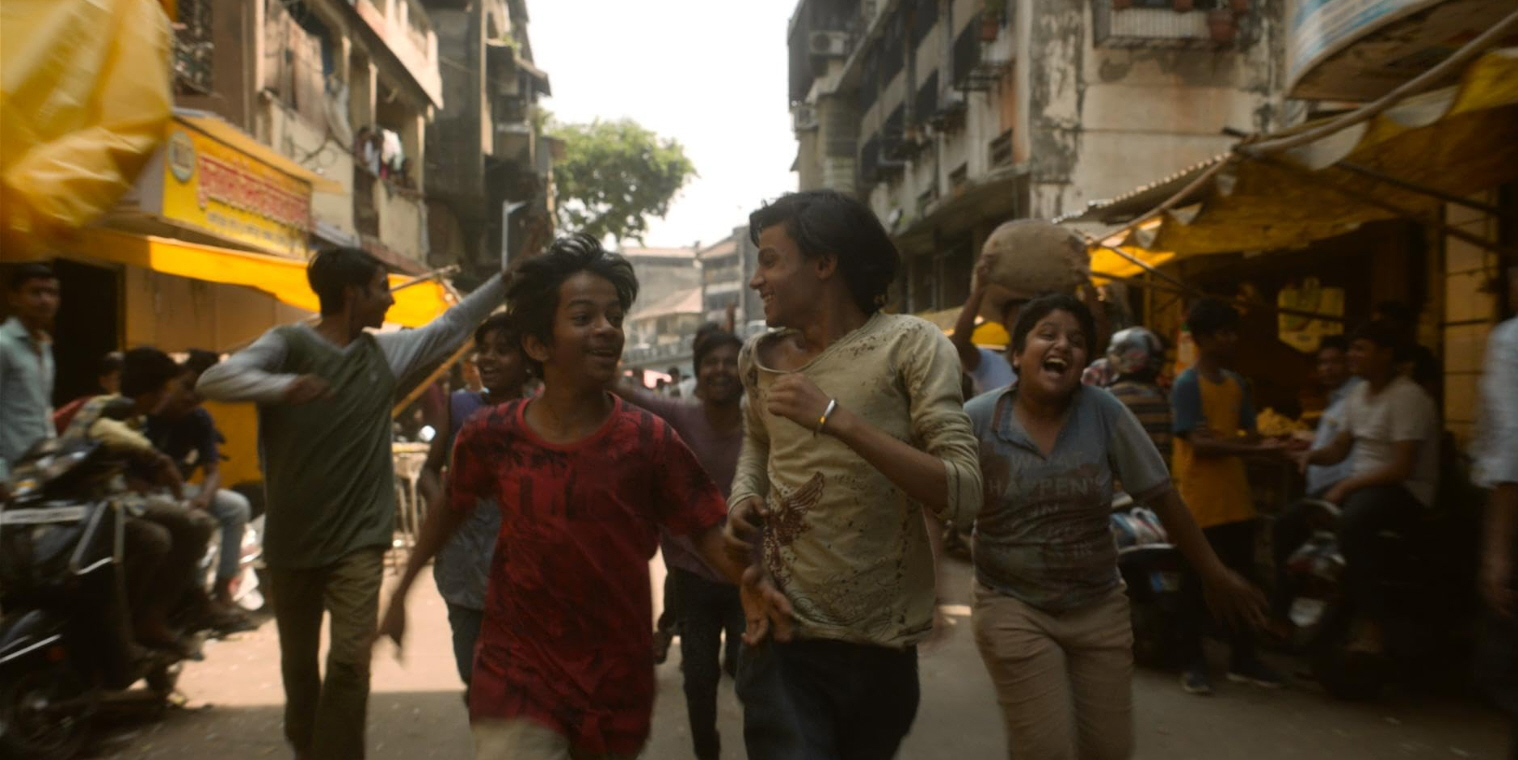
Sagar Bhai is the leader of a gang of orphans that he raises into crack pickpockets. He feeds, them, clothes them, houses them, and asks that they move by his very strict rules – no stealing from tourists, for example, because that attracts too much attention, and Sagar Bhai does not want any unnecessary attention. They move in teams, distracting their marks, and allowing Sagar Bhai’s golden boy, Panchpan (the “55” of the film’s title) to move in and easily lift their wallets. Panchpan (a terrific Rizwan Shaikh) has a routine — before he passes the wallet on to the boy who will take the money out of it and drop it on the train platform, he removes whatever identity card is there.
Because Panchpan is obsessed with identity. He stands in front of a mirror each morning and reads out the names on the identity cards he’s stolen, as if to try on these names for size. Clearly Panchpan wants something more out of life, and wants to be something more than just, well, Panchpan. Identity – being able to have a name, to choose your life – is another of 55’s important themes. But Panchpan’s friend in the gang, known as Chiyasi (86) (Harsh Rajendra Rane), pulls Panchpan out of his morning revery – he insists that Panchpan is just 55, and that for all the gang members, “We are who he (meaning Sagar Bhai) says we are.”
But Panchpan wants something more than the life he has – he asks the very young prostitute Isha if she’s ever dreamed of another life, a different life. She says she never has time to dream, but Panchpan persists, telling her she could be anyone she wants, but this is the life she chooses. She wants to be with Panchpan, but far from the gritty world they both slave in. She wants the dream of a happy love marriage and children.
Panchpan isn’t sure of what he wants, exactly, but he often follows his victims. He’s curious about who they are and what their identity card represents, what snapshot of their lives it distills. He wanders hallways and looks into flats, seeing how people – how ordinary people – live. He’s reassured when he sees a man who has had his wallet stolen assure his wife that they will get new cards, that everything will be fine. This absolves Panchpan of having any responsibly for the consequences.
One day, a man leaves a bank with a bag that he’s clutching to his chest. He’s nervous – as well he should be, because he’s immediately targeted by the gang. Panchpan is sent a photo of the man, who he sees has arrived on the train platform, and the gang moves in. Panchpan steals the large amount of money he has on him, and Sagar Bhai gives them a generous cut of the substantial sum, telling them to go out and enjoy themselves.
Panchpan, though, does his usual routine of tracing his victims back to their homes. He sees the man, distressed, talking to his daughters. Panchpan comes to learn that the money he’s stolen was borrowed for the daughter’s wedding dowry.
Panchpan wants to give the money back, but one of the other boys reminds him about Sagar Bhai’s rules and punishments, and tells him to not to ruin the only thing they have going for them. It serves to cement Panchpan as the outsider he is in the gang, because he sees the results of their actions and the impact they have on people’s lives. This is further emphasized when the next day, while the gang is at the train station, they watch as the man they stole from, desperate, throws himself in front of a train.
Panchpan, of course, can’t avoid thinking about how to help the man’s family, the two daughters who now have no one to help support them. He sublets a flat opposite the eldest daughter, Uma (Dhanshree Patil) and her younger sister Asha (Starr Liu). He’s determined that this is a situation he will take responsibility for, hiding it from Sagar Bhai, and asking Chiyasi to cover for him. Panchpan will continue to steal for Sagar Bhai, but on his own time, he’ll figure out how to help Uma and her sister.
But Uma doesn’t make this easy – she doesn’t want anyone’s help or pity. One of Panchpan’s flat mates suggests that Uma doesn’t need charity, she needs purpose, she needs a way to earn her own way, like everyone else does, every day. This leads Panchpan to come up with the idea of asking Uma to cook meals for him, twice a day. He says he’ll pay for the groceries, the little sister also insists that they are paid 1000 rupees a month. And when Asha is uncomfortable taking the evening meal to the flat full of men, Panchpan begins to eat with the sisters, learning basic rules of etiquette, and what it means to be a family.
Eventually Panchpan is confronted by Chiyasi, who warns him about getting in too deep. And when Panchpan tells him not to worry, that soon enough he’ll be the same old Panchpan, Chiyasi already knows that he’ll never be that again, that this experience has already changed him.
55 is a film dealing not only with identity, but also with hope. The cinematography, with its blue-gray filters, gives us a Mumbai that is real and grounded – in some ways, it reminds me of Payal Kapadia’s All We Imagine as Light, where the colour palate reflects the day to day grind. But this is punctuated by the moments of light, for example, when Panchpan goes to learn about his victims. Surrounded by the darkness of night, these homes are bathed in warm light. The day to day may wear people out, but they have something to go home to, someone, or a whole family, waiting for them.
This is never more obvious than when Panchpan takes Uma to see the home of an elderly man, who was, yes, also one of Panchpan’s victims. They look up at a balcony that glows with the light from within, and the lovely sounds of The Flower Duet by Léo Delibes pours out into the night, giving the two onlookers a moment of beauty and hope. Life might be hard, but beauty is there to be found, and hope will support you through anything. And as viewers, we want this for Panchpan and Uma. We want them to rise above their situation, to break out of the crushing box that seemingly holds no hope for them. We want Panchpan to find his identity – to choose his identity, as Uma later urges him. We want Panchpan to find his place in this big, busy, sprawling city, punctuated with the rattling of trains, a place that isn’t reduced to being one of Sagar Bhai’s minions. This is the film’s greatest accomplishment – giving us a character like Panchpan, a complex, messy, thoughtful character – and making us care about him right until the very end of the film, making us want to know who he will be and what his place will be in the City of Dreams that is Mumbai.
55 is currently playing in Boston, Connecticut and New Hampshire. The film will open theatrically in Los Angeles on September 5th, and will be on VOD on September 16th.